

CRM Is More Than Retention: Building Player Value Across the Lifecycle

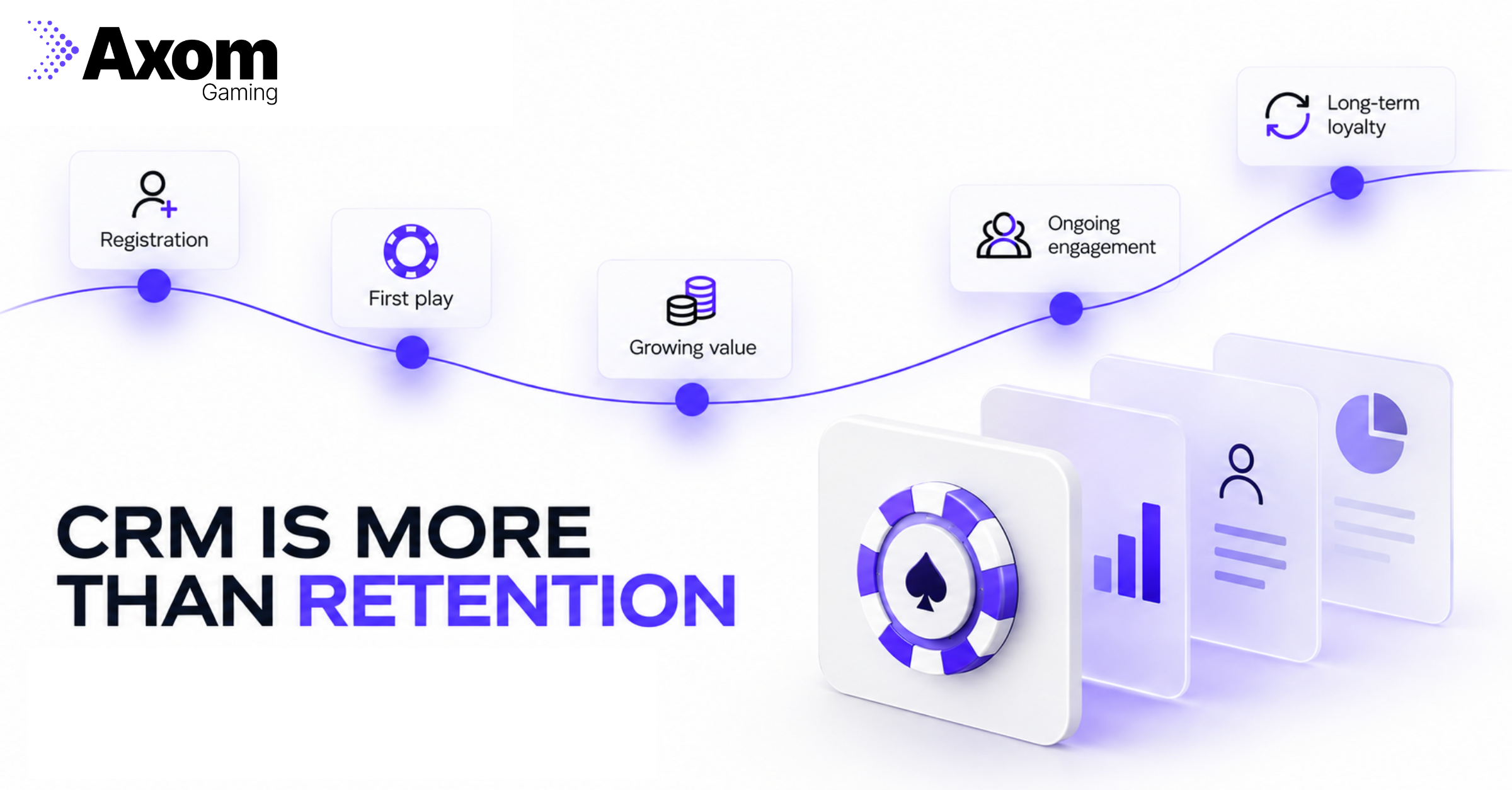
We often hear people talking about CRM and retention as though they are the same thing.
Of course, keeping players engaged, reducing churn and reactivating customers are a huge part of what CRM teams do. But focusing too heavily on retention misses the role CRM can play much earlier in the player lifecycle.
Once a customer has registered and started playing, there is an opportunity to understand how that individual behaves, and in turn what could develop their value over time.
The question isn't simply how you retain a player, but rather how you help each player move towards their optimal value.
The early player journey matters
When someone first becomes a customer, an operator knows relatively little about them. But that can, and should, change very quickly. Every deposit, session, game choice and response to an interaction provides more information about how that player behaves and what they might respond to next.
CRM teams have, over the years, become very good at using that information. Players are placed into segments, enter journeys and receive communications or incentives based on a combination of their behaviour and the rules the operator has created. That approach has worked for a long time and of course it continues to work. But there is an obvious limitation: a segment is still a group of individuals.
Two players can look very similar in the data and still respond completely differently to the same action out in the real world. One might need an incentive to return, while another would have returned anyway. A third might respond better to a completely different action. Treating those players in exactly the same way inevitably means some decisions will be more effective than others.
Moving from segments to individuals
This is where AI is beginning to change what is possible within CRM. Rather than asking what action should be taken for a particular segment, operators can increasingly make that decision at an individual player level. We’re essentially in the position of being able to roll out the red carpet, VIP treatment for everyone.
Importantly, this doesn't actually mean replacing the CRM. Existing CRM platforms are already very good at executing campaigns, communications and rewards. The opportunity is to add another layer of intelligence that determines the best approach for each individual player.
The aim isn't to build more campaigns or increasingly complicated journeys. It's to make a better decision about what should happen next for each individual. That might be an incentive, a different type of interaction or, in some cases, no intervention at all.
More activity doesn't necessarily mean more value
There's a natural tendency in CRM to associate action with success. A campaign was sent, an offer was claimed and a player returned and deposited, so it's reasonable to conclude that the campaign worked.
The difficulty is knowing whether that action actually created incremental value. If a player receives a reward and returns to play, but would have returned without the reward anyway, the operator hasn't necessarily generated additional value. It may simply have given away margin unnecessarily.
This is an important distinction and why the goal needs to be bigger than engagement or campaign response. Ultimately, CRM should be helping the operator maximise net lifetime revenue at an individual player level, which means getting better at understanding when to intervene, what action to take and when intervention isn't necessary.
CRM shouldn't wait for a player to leave
This becomes particularly important during the earlier stages of the player lifecycle. If CRM is viewed primarily as a retention function, there's a danger that too much emphasis is placed on intervening once engagement begins to fall. By that point, however, a huge number of decisions have already been made.
Those earlier stages are an opportunity to learn about a player and help them develop towards their optimal value. As more is learned about how that customer behaves, the decisions made around them can develop too.
We need to be thinking about what comes next for individual players all the time, not just because they have triggered a certain rule. This is a continuous relationship, and we need to be paying attention.
Players don't stand still
Another major limitation around relying too heavily on fixed journeys and segments is that player behaviour changes over time. The way somebody plays today isn't necessarily a reliable indication of how they'll behave next month. Their playing habits, preferences and responsiveness to different interactions can all change, and two players who initially followed very similar paths can end up behaving very differently.
The decisions being made around those players therefore need to be able to change as well. Individual-level decisioning allows the approach to adapt as the player does, using what is continually being learned about that customer rather than relying solely on where they currently sit within a predefined journey.
In practical terms, it shifts the question from simply asking where a player fits to understanding what the most appropriate next action is for that particular person at that particular time.
Better decisions throughout the player lifecycle
We've already seen what this approach can deliver in practice. In a three-month trial with 888AFRICA, Axom Gaming's individual-level decisioning delivered progressively stronger results, reaching 18% higher NGR than the operator's existing CRM approach by month three.
The bigger story, though, isn't one result from one operator. It's what becomes possible when CRM teams can make better decisions at an individual level throughout the player lifecycle.
Retention remains a hugely important part of CRM, but it shouldn't define the entire conversation. From a player's earliest interactions onwards, every decision has the potential to influence how their value develops over time.
The opportunity is to make those decisions based less on what a group of similar-looking players might do and more on what is appropriate for that individual at that particular point in their relationship with the operator.
That's where CRM is heading, and it starts long before retention becomes the problem.
Ready to think beyond retention?
Axom Gaming works alongside your existing CRM to bring individual-level decisioning across the player lifecycle, helping you make better decisions for every player and maximise net lifetime revenue.
If you'd like to see how that could work with your existing CRM and player data, talk to the Axom Gaming team.
%20(1).png)
.png)
%20(1).png)